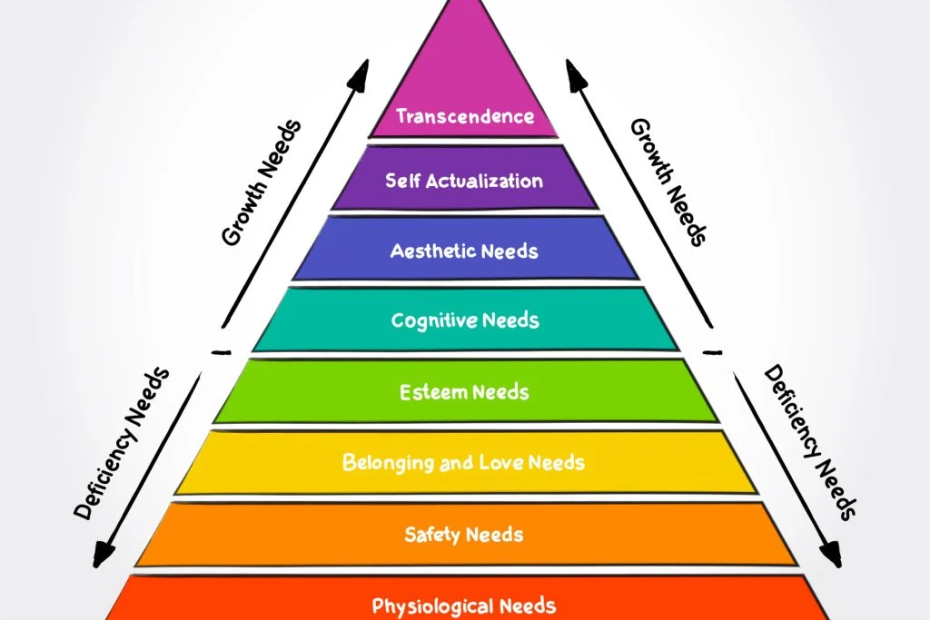
For those that have never heard of it Maslow’s Heirarchy of Needs was a theory of motivation fire published by Abraham Maslow in 1943. It provides a framework for understanding the needs of human beings for their holistic well-being. It gives a list of the fundamental needs for a human being, from the most basic needs of breathing to the most expansive and profound such as the quest for transcendence. While it has received some due criticism, many find it even on simple observation a beautifully simply capturing of the human condition. It’s regularly used in psychology and sociology as well as in the applied fields of management and education. Less recognized is it’s role in game development and game-based learning.

Any system of motivation is of key consideration for game developers. Games, especially educational ones, are about managing player motivation and understanding. Game developers should learn the concept to help their understanding of human dynamics, but society should also understand games potential role in addressing the fundamental needs of humanity. While many dismiss games as mere entertainment, their primary function of addressing human motivation to convey knowledge to develop mastery, is the key to human growth. A more mature, thoughtful and far-sighted vision of games and their potential can help unlock a more fulfilled and capable future for humanity. This may seem like a hyperbolic statement, but it is true. Games and play have been at the heart of learning from the first rock throwing game teaching hunting skills, to the wargame simulations we use today to train generals for the potential of worldwide nuclear war. Understanding the true potential of games, and implementing them through education, both formal and informal, can empower a deeper and more powerful system of learning we can ensure a more literate, thoughtful and capable generation of humanity than ever before.
If we want to utilize this tool we need to understand it in the context of what games are or can be used for. As a medium they can be as varied and deep as the use of film, music or literature, we only have to choose to pursue those potentials. The costs of video game development have been a significant pressure on the design and purpose of games, with profit motives shifting games towards the most financially lucrative forms, but I believe we’re about to enter an era of a significant broadening of focus for games, and hopefully some of the potentials discussed here will be passionately pursued. So lets look at the different levels of need in the Maslow system, and how we see games playing a role.
Physiological Needs
At the lowest level, the most base needs of a human being are the fundamental requirements of life – air, water, food, sleep, etc. As such physical demands it’s hard to imagine the concept of a game being able to address these things. Some may even think of gamers playing late into the night and perhaps even acting directly in opposition to that need for sleep because of games. This is of course an example of the hierarchy in action, the players need for satisfaction of gameplay overriding their need to sleep or get up and go to the bathroom sometimes.
However if we look specifically at this level itself, we can’t claim games are helping anyone breath, but they can and have helped with food. As I mentioned above rock-throwing games are an ancient and common practice, likely extending back through to pre-human sapiens. They are some of the most primordial games, and their practice is quite obvious. By making a game of throwing a rock, with even the simple premise of pick a target and try hit it, the “game” encourages and practices one of the most uniquely human skills and needs in prehistory – the ability to kill prey at a distance.

As a species our ability to defend ourselves at range, and to hunt are critical to our survival. Our notable lack of physical defences and weapons, our short weak nails compared to claws, our thin, delicate, not even fur protected skin, our short, inset teeth, we have little ability to compete with the world of predators our ancestors dealt with. Throwing things was a uniquely human strategy to hunt for food and keep predators at bay. Games were how we train to be good at this. We can even see that human brains are uniquely good at predicting ballistic curves over other species. We have evolved to be better at throwing, but it still requires practice.
From our earliest days, even before humanities earliest days, we as a series of species, have used games and play to ensure our physiological needs. Today we still see children play to emulate the jobs that adults do to provide for their family, as they always have. We may play with toy bulldozers, animals and cook sets to emulate our builders, ranchers and chefs, but the principle is the same. We become capable of our most basic needs through play, even if we’ve socially evolved new ways to get those needs met.
Safety Needs
With the basic physiological needs met, the next level is the motivation securing themselves from harm – their health, personal, emotional and financial security. We want to be out of harms way, but we will bear danger in order to fulfill our physiological needs if we have to. Seeking to minimize the threats to our health, avoiding violence, threats and dangerous predicaments, we also extend this fear motivation to cover more mental concepts. We seek out emotional peace, generally wanting to avoid sadness, fear, and anger. As a social species we’ve extended this concept of safety to finance in materialist/capitalist societies as currency became the means of securing the means of life. Again most people would see this level of need as beyond the scope of mere games, but in fact it again has ancient roots to play and games.

Dolls and representative figures are an ancient form of art and game. The earliest known carved figures we’ve found so far include the Lion-man or Löwenmensch figurine. A human/lion hybrid character cared of mammoth ivory, it’s been carbon dated to around 40,000 years old. Of course softer materials, like cattail dolls were likely used as early or earlier but would be very unlikely to be preserved to modern day. Why representative figures are important is conjecture, but our most common example in every existing culture on earth is the use of companion dolls for role-play. Much like our earlier example of rock throwing games, role playing with dolls, especially in caregiving, is a critical training method for a fundamental need in society. Our safety needs are communal, as a social species we’ve adapted and adopted any number of habits to help care for each other, providing safety in numbers. These are skills needed to be learned, and through mimicry and role-play we have always worked to prepare our children for these concepts as they grow.
In the modern world, the pandemic showed how games were a very valuable tool in providing the safety needs of people, especially youth. With the need to quarantine children had their social development threatened by isolation. Social aspects of multiplayer games were an avenue for kids to maintain their health while avoiding the loss of their emotional support network of peers. Isolating jobs, like military deployments and remote location mining/logging shifts, can benefit from these same principles providing for adults as well.
Belonging and Love Needs

Humans are social creatures. We see various ills befall those that are isolated. Humans need some way to have contacts, family, friends, colleagues, associates, a tribe of some format. We seek some degree of social life, most pointedly, to feel love, belonging, a sense of place and appreciation. With our above example it shouldn’t be hard to see how friendship is an easy part of what games offer to humanity. It’s more than just a social exercise in fun building friendships, or their ability to be a communications platform. We’ve seen sports used as an example for this need in the past century, but digital forms of play and community are a new extension for meeting these needs. Games can be a good way for people to built trust, acceptance and intimacy. As people play together, both competitively and cooperatively they can explore interaction and social dynamics. This includes self-expression, appreciation, trust, and acceptance. Continued relationships can build towards intimacy, especially in games with the ability to create and express oneself through creativity tools.
Esteem Needs
The other level of psychological needs in the Maslow pyramid is Esteem, the value and respect, both socially and internally. People need, want and are motivated by the concept of being valued and respected. This includes the desire for status, fame, prestige, attention, as well as the internal senses of competence, mastery, confidence, independence and freedom. These concepts both internal and external are often the measure of “success” a person feels in life. The motivation to achieve these is often the basis of most wider social and cultural interaction – pursuits in careers, education, hobbies. Games are most classically associated with these form of needs, they are often based on defined goals and actions leading to clear success or failure moments. Perhaps nothing else in human endeavour has so masterfully worked to understand and apply the human needs of esteem like games. High scores, rankings, achievements, unlockables, winning bouts, minigames and entire games all tap deeply into these needs. The motivation systems of games are incredible examples of speaking directly to the needs of this level. You can read our article How People Connect With Games for more on motivations of players.
Cognitive Needs
At the Cognitive level we deal with the human drive to know and understand. Humans seek out knowledge, understanding, they explore, investigate, pry, manipulate, all to gain information and comprehension. These cognitive drives help humans learn from their environments and from others, both passively (perceiving) and actively (exploring/manipulating). Living in the information age, we can see how powerful this drive has been for the development of society through our acquired knowledge, technology and education systems to preserve and propagate these benefits. Games are an incredible tool for cognitive development. They are an incredible tool for education as many of our other articles show. They offer an incredibly deep and meaningful way to convey information and provide tools for comprehension. Their depth and generative capacity speaks to the curiosity within us. The ability to see systems in action, and in interaction, to predict, resolve and review complex systems over time are incredible tools for deep knowing. When properly aligned with important concepts and real world implications we go from curiosity through gaining information to true understanding and meaning.
Aesthetic Needs

Beauty is often seen as a superficial aspect of life in the modern era, but it has much deeper meaning and sublime grace when seen through the lens of ancient philosophy. Many ancient Greek philosophers consider the beauty of the natural world as a sign of the divine providence of creation, a means of shared joy inescapable to anyone born into the world. Aesthetics isn’t a mere coat of paint to change looks, it’s the inherent form and flow of physical creation. Beyond the aspect of nature, it includes beauty, artistry, pleasure and even the sense of novelty. Any media is inherently tied to the expression of the aesthetic, and games are no different. To convey their meaning, action, mechanics, purpose, and/or story, they must use an aesthetic. Games have the advantage of being multimedia, they can use audio, visual, and textual sensation to convey their aesthetic. With the capability to interact and explore them to the custom desires of the player, they offer the deepest sense of aesthetic yet. While fidelity, accuracy to nature, has been a major driving force in games so far. Now that technical capabilities are so deep they are touching on photorealism, I believe this dogged pursuit of realism will start to ebb and the true novel exploration of aesthetic will become far more common.
Self-Actualization Needs
Depending on the version of Maslow’s Hierarchy of Needs you see it will either be topped with Self-Actualization or Transcendence as the highest level of needs. Self-Actualization is the becoming of the self, achieving and being the ideal of one’s own vision for oneself. Freud gave this concept the term ego-ideal, and later superego. The values, principles, goals that we hold as best and our desire and aim to achieve and become them. The Bhagavad Gita in many ways addresses the goal of becoming the best most true form (which formed from the divine is inherently divine and sublime in nature) of oneself as one’s holy duty. Taoism extols the goal of being the most inherently true version of oneself that will inherently have perfect harmony with nature, as it is a part of the divine and true nature of the universe. A human’s view of themselves and who they want to be help drive their goals, which determines their developed talents and success. In games developers try to create goals that speak to a player’s interests and desires, and the drive for self-actualization motivates them to succeed at these tasks, while other needs may also be met. Through completing tasks or achieving things in a game players can see their success and can identify with success and the specific tasks, abilities, achievements, world effects and roles that they acted on. Games offer a fantasy world to roleplay scenarios and personalities to fulfill both preexisting goals and concepts of self, and discover new ones. Through both narrative and social games they can also extend these goals, successes and self-identify and fulfillment through relationships and the social dimension of self-actualization. This includes not just the sense of community we discussed in Belonging and Love Needs, but extends to roles in communities – fame, authority and recognition in the social dimension provide the fulfillment of many common superego desires. Games make these roles more plentiful and accessible to individuals so they can be experienced and explored more easily allowing for practice towards potential real world leadership and achievements.
Transcendence Needs
Knowledge and understanding beyond the limits of ordinary human capability is a tall order. Humans, at their best, strive for the highest ideals, the meaning of creation, the purpose of life. These highest ideals and questions are our highest need, leaving far behind the drudgery of our mechanical base needs. The common perception of games as entertainment, and often childish entertainment, may mean that most would utterly dismiss their potential role at this level. Again though, games are simply a medium, as capable of transcendent wisdom and beauty as any art form, it’s merely up to the artist to achieve such monumental work, and for it’s message to be received in the right light by the right people. Cultural priming and the economic pressures on the medium (largely from its complexity and cost of development) are likely preventing games from having as strong role here as we’ve seen in literature and painting. That doesn’t mean they can’t or they don’t have value to transcendent growth. Spirituality is a part of the human experience, and the question of how values are formed, how those values are expressed, and how the expressions of values interact in the world are all commonly used in games, even if they aren’t recognized. Values, virtues and ethical decision-making are the basis of narrative, some games simply highlight or downplay this more or less than others. We can see in the Ultima games, especially Ultima IV, a game whose fundamental purpose was to have the player explore meaning through reflection upon, and embodiment of, a system of 3 principles and 8 virtues. I would argue that, given its technical limitations of a game released in 1985, it provides players a wonderful experience in dealing with the transcendent and spiritual. Other games specific to denominational worship have taken more blunt approaches of merely “skinning” a game in religious imagery, but the medium is capable of presenting and exploring deep ethical and spiritual scenarios. We’ve only just begun to touch the surface here, but as the world becomes increasingly game-immersed, there use and sophistication in approaching the transcendent will only improve.
The Bottom Line
Maslow’s Hierarchy of Needs is a wonderful way to reflect on what it means to be human. While it’s a common tool in sociology, psychology, and education, I think more game designers should familiarize themselves with it. Ideally more publishers will take an interest in it too, so we can see the full potential of games better understood and better supported. Games have been a fundamental part of human learning and development since before we were human, better recognizing that fact we can truly unleash their potential.
If you’re interested in having a game developed that speaks to the full development of humanity, Massive Corporation is here, we’ve got the deep educational and game development knowledge and skill to address the big issues and ideas through games. We’d love to hear your ideas about how games can and should be used to holistically address the development of humanity. We offer free consultations, so drop us a line and lets talk about your project! We’d love to help bring to life more great games that help people grow and be the best they can be!